


Read It on Paper. Your Brain Will Thank You.
In the digital age, it can be challenging to balance our use of technology and know when to turn the screens off. Especially when it comes to using technology in learning.
At My Tutoring Partners, we want to help you and your family find a balance between the convenience of technology and the effectiveness of hands-on, human-centered learning.

According to an article titled “We Put Reading on Screens. It Backfired.” by the Preamble, studies across Europe, North and South America, and Asia show that the percentage of students regularly using digital technology for learning purposes increased by nearly 40% between 2003 and 2022. During that same period of time, academic performance fell by about 20 points.
We talked to one of My Tutoring Partners online tutors, Matt Carsel, and asked him his thoughts on learning and teaching in the digital age. He said he notices a profound difference in his students between reading online versus reading physical materials.
“With online (reading), we do a lot more skimming. The brain’s not even wired to store that information into launch or memory,” Carsel said. “If I’m doing an exercise with a student that requires reading a short passage and looking for evidence or context in order to answer questions, their ability to locate information that they’ve just read doesn’t exist on a level that existed even a decade ago.”
The article provided data that proves Carsel’s point. Research shows a staggering find: reading from a screen produces poorer comprehension than reading from paper. When researchers focused on reading expository texts (meaning “reading for learning” texts), the disadvantage doubled.
The article argued that an issue with reading online is the inability to detect spatial awareness on a page. When the brain cannot detect where it is on the page, it cannot determine how much has been read and cannot recall where information is found.
The article states:
“Have you ever tried to return to something you’d read in a digital document, only to discover you can’t find it? You know it was there a few scrolls ago, but now it’s gone.
That’s because your brain is searching for a place — and on a scrolling screen, place is constantly changing.
Much like a GPS, the hippocampus (one of the brain’s key memory
structures) builds a continuous mental map of the world around us.
Importantly, each time we learn something new, that information becomes
tied to the spatial context in which it was learned.
Paper naturally provides words with a fixed, physical location. If you’re
holding a print version of this article right now, then this sentence exists right
here, and this spatial position will become part of the memory you’re forming.
This spatial anchoring is why readers can often recall where in a book
something appeared (about 20 pages in, on the left-hand page, near the
top), even if they can’t recall the exact wording.”
Carsel combats this issue of spatial awareness during online tutoring sessions by using digital reading materials that have line numbers so he can refer to a line or paragraph number, helping students with spatial awareness and recalling information.

In a digital world, it is unrealistic to claim we should all go back to using physical learning materials all the time. The convenience of traveling with a Kindle, or having access to all your textbooks on a laptop allows society (and especially homeschool families) to have flexibility and convenience like never before. There is, however, a time and a place where physical materials serve the learner best. And although that is true, we also do not need to rule out all online materials when it comes to learning.
Whenever possible, Carsel utilizes physical books during online tutoring sessions. He encourages families who use online tutoring to obtain a physical copy of a book, and he reads along with the student using his own book at home.
To encourage the student to read at home, Carsel suggests scheduling time for it in the calendar. He also suggests getting two sets of the same book (bonus points if they’re different editions!). He said swapping reading between parent and child can be very beneficial for a child’s learning and desire to read.
“If they’re the only ones doing the reading, it becomes work. And if you’re the only one doing the reading, it becomes passive and the mind is allowed to drift,” Carsel said.
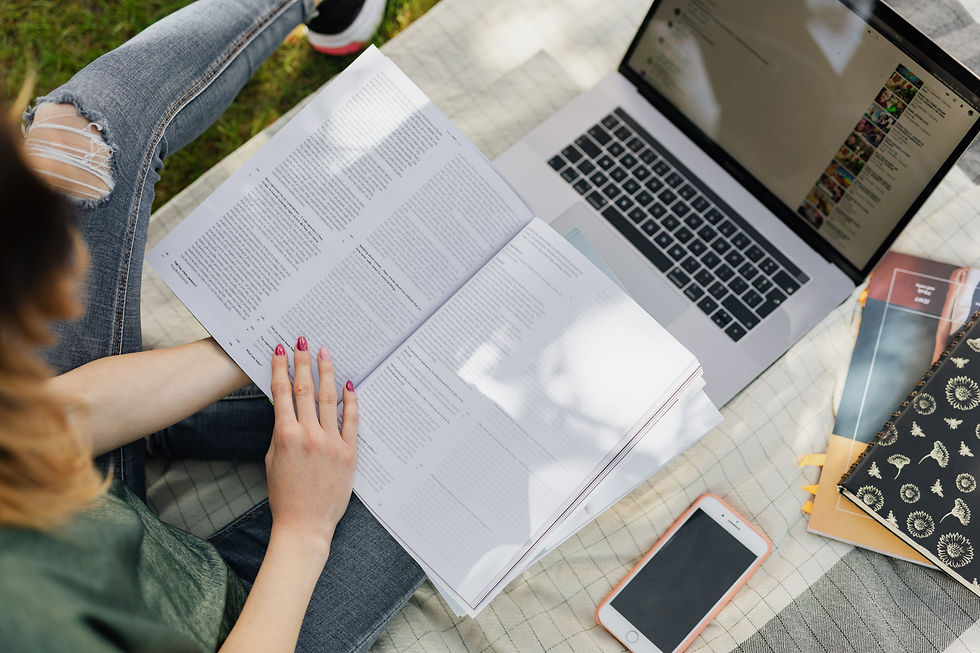
In 2024, the SAT assessment transitioned to being fully digital. Originally, students read longer passages of about 750 words and answered ten questions about each passage. Now, students read 54 short passages of about 75 words and answer one question about each passage.
The skill of reading comprehension is being redefined to adapt to the shorter attention spans we are seeing in the younger generations.
“Teaching has changed to adapt to the way brains are now wired, as opposed to us helping to hardwire those brains to have the skills that we have felt were important for centuries,” Carsel said.
Carsel encourages learners to use digital learning tools as enriching and supplemental, as opposed to it being the singular mode of receiving information.
A good practice for using more analogue reading materials is to prioritize them. When you want to check out a book from the library, consider going in person and looking for the physical copy before borrowing the e-reader edition. Instead of opening a news app, read the newspaper or a magazine from the same news outlet.
Digital learning has re-defined what it means to be a student. Students no longer have to adapt to a one-size-fits-all approach to learning. There is flexibility to learn in ways that work best for students and their families (like online tutoring sessions!). There are many benefits to this new-world of digitization.
At the same time, let’s work together to create a balance. Don't we want the younger generations to know the wonder of the smell of a book or how it feels to hold one in your hands and turn a page?
As teachers, parents, and tutors, let’s come together and help our students utilize best practices with balancing digital and analogue reading so they can experience the lasting benefits and, in return, shape generations to come.
My Tutoring Partners is hosting a Reading Challenge! Here is how to enter:
Fill out this form telling us what books you read in the months of September and October
Submit your form by November 1
We will choose one winner to win a Barnes and Noble gift card!
*Be on the lookout on our social medias for ways to get more entries!*
Student must be currently receiving tutoring from My Tutoring Partners. Each student can submit only one form.


Comments